Sunday, September 25, 2016

What is the Fourth of July?

            What is the Fourth of July? Many people would say the answer is simple: independence day. But in a country as diverse as the United States this question could be answered a thousand different ways. Lots of Americans view this as a day of celebration with family and friends. However, in Frederick Douglas' speech, "The Meaning of July Fourth for the Negro", he states," Fellow citizens, above your national, tumultuous joy, I hear the mournful wail of millions! whose chains, heavy and grievous yesterday, are, to-day, rendered more intolerable by the jubilee shouts that reach them". In this quote he is referring to the millions of slaves who have not yet been freed. How then can America rejoice in their freedom when all are not free? Douglas raises this question throughout his speech and prompts his fellow citizens to make a change. Since this speech was written in 1852 lots has changed. However, we are still a very divided country. There is still lots of discrimination that occurs each day throughout America. Many people say that we have made great progress in achieving equality among all races, and that is true but we still have a long way to go until we fully achieve equality. Another example of a race who is often discriminated against is the Native Americans. Looking at Fourth of July from their point of view you would imagine they would love the holiday right? I mean they were the first Americans. Actually, many Native Americans hate the holiday. For them it is just a painful reminder of the tragic history of their ancestors. To them the fourth of July celebrates the very people who forced them off their own land and almost ruined their whole culture. So for many people the Fourth of July is a day full of celebration and fun with the ones we love the most. But next Fourth of July we should also take a moment and think about how it would feel to be a member of a minority on a holiday solely for the majority.

Click here to listen to the speech by Frederick Douglas:

Image result for july fourth

Image result for july fourth for the negro

Sunday, September 18, 2016

Memorial for the Missing: Menin Gate

  
     The Menin Gate Memorial was built in 1927 by Reginald Blomfield. The memorial stands in Ypres, Belgium to commemorate the British and Commonwealth soldiers who fought in the Ypres Salient of World War 1, but have no known grave. This memorial is the one of the most visited in Western Europe. I chose to research this memorial because the architecture and history are very interesting. The memorial is built over a moat that the soldiers passed as they marched out of the city and into battle. However, the bridge was so dangerous due to shelling that many soldiers opted to go around it rather than cross directly. One poet, Siegfried Sassoon, wrote about the soldiers in a poem that reads,

 “Who will remember, passing through this gate,

The unheroic Dead who fed the guns?”

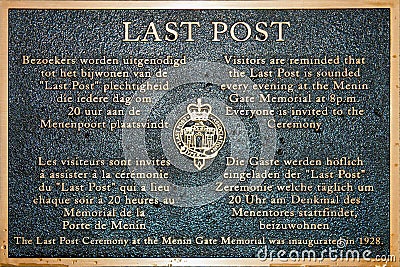
This poem explains that the men who will remember passing through the 'gate', instead of the memorial, will not be able to tell their story themselves as they were lost long ago. Originally, the site of the memorial was old town ramparts with just a bridge and two lions to the side of the bridge. The architect included the two lions in the memorial, one facing east toward the front line and one facing backwards towards the center of Ypres. These lions represent that there are two goals of the memorial, to look back and honor those who lost their lives in the war, and to look forward and cherish the life that they have because those soldiers fought to keep them free from German rule. Another interesting choice the architect made was to add columns on the outside of the memorial. This adds to the feeling of honor and valiance that help to remember the soldiers. On the inside and outside the names of 54,896 men are engraved into the memorial. Along with their names are their ranks in the war. By engraving their ranks as well as their names it gives the soldiers an identity. This shows that they had a place in live, that they are not just another name on a wall. But that they were real people who did amazing things for their country. However, the aspect that I found most intriguing about the memorial was its location. The memorial was built in Ypres because a large amount of soldiers were known to have fallen there. The architecture chose to build the memorial in this exact location because it was an integral part of the war. Most soldiers had to cross that bridge or 'gate' to get to the front line, and many died there due to shelling. I thought this was really interesting because, besides the obvious ties this location has to the war, it also could demonstrate the link between the dead soldiers and the living. By walking through the memorial you can imagine the soldiers journey bridging from life to death. Each night at 8 pm the 'Last Post' is rung to remember these brave soldiers. It has been rung every night except for when Belgium was taken over by the Germans during World War 2, but immediately begun again the day the Germans left. This location is still very important, even though there are no more battles there, just as the soldiers are still very important, even though they aren't fighting anymore.
Information from: http://www.historylearningsite.co.uk/world-war-one/world-war-one-and-casualties/the-menin-gate/

Menin Gate Memorial to the Missing Image result for menin gate at midnight Image result for menin gate memorial

Image result for menin gate memorial Image result for menin gate memorial Image result for menin gate memorial