Sunday, December 18, 2016

Never Stop Dreaming

      I remember being a kid, when everything was a dream. I dreamed out my entire life. I would grow up to be an actress, I would have six kids, a wonderful husband, a mansion, and a purple sports car. Pretty unrealistic right? Now maybe, but when I was seven years old, anything was possible to me. In fact the bigger the dream, the better it was. But I guess as you grow up reality has to set in. Now, I don't aim to be an actress, I want to be a lawyer. I hope I'll have a wonderful husband, but I'll settle for three kids, it's a little more manageable than six. And I think I’ll trade in my mansion and purple sports car for a cute two story house in the suburbs and a nice soccer mom van. This is my new dream. I still like to entice myself by dreaming up unrealistic futures for myself in which I'm living my childhood dreams out, but like I said, at some point you must grow up. Times change and people change, sometimes your dreams must too. However, Beneatha from A Raisin in the Sun refuses to accept this. She wants to be a doctor in a world in which women don't do that. After all, "It's not every day a woman decides to be a doctor," (A Raisin in the Sun). Beneatha refuses to accept this stereotype and tries to pursue her dream, even if she is ridiculed for doing it. So which way is right? Altering your childhood fantasies so they become realistic, or refusing to let go of your dreams? Maybe they both are. After all, C.S. Lewis once said,"You are never to old to set another goal or to dream a new dream." 


57 Songs about dreams: https://spinditty.com/playlists/Songs-About-Dreams-and-Dreaming

Image result for dreams

Sunday, December 11, 2016

Is wealth beneficial or detrimental?

     In my opinion, wealth isn't really beneficial to people. In fact, I think it's more detrimental than beneficial. Now, before I come off sounding crazy, let me explain myself. 

     In The Great Gatsby, the entire novel is characterized by wealth. Who can you marry? Someone who is high up on the social change, and has lots of money of course. How does Gatsby plan to impress Daisy? By throwing extravagant parties to show everyone, especially her, just how much money he had. And Myrtle? She doesn't have an affair with someone who is poor, oh no, she has an affair with Tom who is clearly higher class than her husband, Mr. Wilson.   All their decisions are motivated by their desire for one thing: wealth. These people put wealth before everything else in their lives, and in each case it eventually leads to their downfall. 

      As for the detrimental effects of wealth in The Diamond as Big as the Ritz, I think it’s safe to say that each characters life was severely altered due to the wealth of the Washington family. The sisters, for instance, were merely fools who were kept so out of the loop of the rest of the world that they weren't even aware that slavery had been abolished ages ago. And Mr. Washington, well his wealth led him to the conclusion that he was almighty, he even believed he could bribe God. This platonic conception of himself and his wealth that Mr. Washington holds soon leads to his, as well as his wife and son's, death. 

     So, if you ask me, wealth only leads to destruction and devastation. Bob Marley once said, "The greatness of a man is not in how much wealth he acquires, but in his integrity and his ability to affect those around him positively," and I couldn't agree more.

 Image result for wealth photos
Image result for wealth photos

Sunday, December 4, 2016

My Favorite Passage


       My favorite passage from the Great Gatsby is on page 125, paragraph 2. It starts with a rather passive aggressive statement. Fitzgerald writes, "There is no confusion like the confusion of a simple mind," (125). But he does not stop there. Fitzgerald goes on to explain how Tom's "simple mind" is becoming "confused". And this "confusion" is cause by, of course, two women: Daisy and Myrtle Wilson. He refers to them, not by name, but simple as "His wife and his mistress," (125). This, coupled with the exclamation that they were "slipping from his control," gives the impression that they belong to him.

       This paragraph also discusses the motif of speed. Fitzgerald writes, "Instinct made him step on the accelerator with the double purpose of overtaking Daisy and leaving Wilson behind," (125). This supports the claim that speeding makes people feel more in control of their lives. In this passage Tom is attempting to run away from the issues that he has created. He is simply trying to regain some of the control that he has lost. But of course you cannot simply run away from a difficult situation. This is shown by the last sentence of the paragraph, where "Form meets content," (Valentino). This sentence is clearly a run on and could have easily been broken up, but Fitzgerald keeps it as a run on because it symbolizes the fact that the struggle in Tom's mind is not over. This passage very clearly touches on multiple key points of the novel, and that is why I chose to blog about it. 

Sunday, November 27, 2016

Why do we lie?

       Why do we feel the need to make things up? To make ourselves seem like people we are not? To tell 'little white lies'? To be honest I don't believe there's a simple answer to this question. As hard as it is to admit, most of us are probably almost as bad as Jordan Baker when it comes to telling the truth. On page 57, Nick tells about a time that Jordan lied. He writes, "When we were on a house-party together up in Warwick, she left a borrowed car out in the rain with the top down, and then lied about it." This is one of the multiple examples Nick gives that support his claim that Jordan is a liar. In this case, she is lying about something that isn't even a big deal, but rather a simple mistake. However, for some reason she feels the need to lie about it. This happens still today. Although everyone knows that it is wrong to lie, many do it anyway. Some people don't even realize that they are lying, they are simply "incurably dishonest," (Fitzgerald 58). However, most people avoid telling exaggerated lies that heavily impact the lives of others. Instead, people tend to 'bend' the truth to make it seem as if everything is going the way they want it to. People tend to tell stories that enhance the image that others have of them, often by changing a couple minor details. This accusation isn't to say that everyone is "incurably dishonest," (Fitzgerald 58) or even that everyone has ever lied. This is just to say that often times people find it easier to tell a small lie, rather than suffer the embarrassment that may accompany the truth. But as to why we feel the need to do this, there is no exact answer. The best answer I could come up with is that we do it to protect ourselves. We 'bend' the truth to ensure that our images and reputations aren't damaged as a result of something minor. 

Sunday, November 20, 2016

Is Society Truly Against Rape?

     Rape is one of the most difficult and uncomfortable topics to talk about. Unfortunately, rape is a key event in the novel The Bluest Eye. Pecola is raped twice by her father, which causes her to have a mental breakdown. But when Pecola tells her mother what happened, she doesn't care. Morrison wrote, "So that's why you didn't tell her about the second time? She wouldn't have believed me then either," (200). This quote is taken from a conversation that Pecola is having with herself; she is clearly traumatized by what happened to her. And the depressing fact is that this same thing happens still today. Millions of people are raped each day-and most fail to report the assault. You might wonder why they don't report it, why they don't try to get justice for themselves. The answer is simply the same as the one Pecola gave to herself- "[they] wouldn't have believed me then either," (200). In fact, 54% of rapes are never even reported (Huffington Post). And why would you when rape victims are constantly being blamed for being assaulted? Or being judged because of something they never wanted to happen? In The Bluest Eye, this is exactly what happens. The others in the town look down upon Pecola because of something that was out of her control. Today, even if you managed to get your story heard, there's no guarantee the investigation would ever be completed. In 2009, 11,000 untested rape kits were found in evidence boxes in Detroit, (mlive.com). These victims never even got a chance for justice. Since then, a law has been passed that requires these tests to be tested within two weeks of a victim coming forward, (mlive). As a society it is clear that we are making progress, but we have so much more to do before we can ever say-truthfully- that we, as a society, are wholeheartedly against rape. There is a clear need for quicker and more substantial changes in the society we live in today. 

Image result for rape victim blaming cases

Image result for rape victim blaming cases

Image result for rape victim blaming cases

Sunday, November 13, 2016

Beautiful Irony

        In 2014 2.8 million teens had one or more major episodes of depression (Teenhelp.com). Sorry to start off this post with such a sad fact, but depression is one illness that doesn't get nearly enough attention. Depression is all too common among teens and adults. In fact it's the most common mental illness in the United States (Teenhelp.com). And why is that? The answer is simple and right in front of everyone-technology. Or to be more specific, the beauty standards that technology allows people to share each day. Depression is an issue that was relevant in the 1900's and still is today. Pecola struggled with hating herself because of how she looked, much like teens do today. It's impossible to go on Facebook and not see a beautiful model staring back at you- practically judging you as you sit on your phone instead of working out like you promised yourself you would. Or maybe you prefer a magazine because paper can't judge you, or can it? You grab a copy of the latest Cosmopolitan and the first thing you see is an article for working out-everyone's tweeting about it. It's basically telling you, "Don't be the only lazy one, learn to love your body-all you have to do is change it."


How are you supposed to learn to love yourself when everything around you says you aren't good enough? One song by Pink, Don't Let Me Get Me, explains this feeling  perfectly, "LA told me, you'll be a pop star, all you have to change is everything you are. Tired of being compared to damn Britney Spears, She's so pretty, that just ain't me." Society tells you to love who you are, but creates standards of beauty that are so unreasonable even a "pop star" can't achieve them. Depression is caused by any number of things, but the most relevant is the feeling of being unworthy. The feeling of looking in the mirror and just hating what you see. And I can almost guarantee that everyone has had that feeling at least once before. But why? Why do we look in the mirror and judge ourselves so harshly? Because society says that if you don't fit specific and ridiculous standards- you can't be pretty. So when we look in the mirror, all we see is ugliness. The irony of society is beautiful. "Love your body- The 15-min workout everyone's tweeting about." Society wonders why everyone is depressed, maybe if it looked in the mirror it would understand.


"Don't Let Me Get Me" by Pink: https://www.youtube.com/watch?v=K_t9AA3Z4PE

Sunday, November 6, 2016

Pretty vs. Beautiful

                In writing this blog post I really wanted to dig deeper into the topic that Morrison writes about in The Bluest Eye: beauty. Ever since I was little I heard the words pretty and beautiful used, almost interchangeably, to describe different women. While I do understand that sometimes these words are used to describe men, more often than not they are directed towards women. When I was a little girl my mom would always tell me I was, "beautiful inside and out." As a kid I never really understood what this meant, to be honest I thought she was just telling me I was pretty.  So when I sat down to write this post I decided I wanted to figure out just what these words meant, naturally I googled it. The first result to show up was: https: //www.youtube.com/watch?v=jKTZAsDVkzs . After watching this video, I realized that beautiful and pretty are not interchangeable. I found that to be pretty most nearly means to look like the beauty standards set forth by society. However, one of the women in the video said: "[Beauty] is something that comes from the inside out, it's a combination of who I am and what I bring to the table." This really made me consider what I believed to be the definition of beauty. The next video I found was one in which blind people talked about the meaning of beauty to them (https://www.youtube.com/watch?v=hlcx_q8u_YI). This video truly made me think of things from a different point of view. I started to think, every girl in school doesn't like the same guy and vice versa. So that means that "beauty [truly] is in the eye of the beholder." In the video one of the men said that he believed beauty to be experiences. To me this video was very powerful because it really illuminated the idea that beauty is not just looks. After watching these videos I understand that although we live in a society where being pretty is practically essential, when it really comes down to it beauty is what's most important. Being pretty may make you the 'it girl' in high school, but without a kind heart the 'real' world will be a cold, unforgiving place.

Some music videos I found relevant to this topic:

Sierra by Maddie and Tae: https://www.youtube.com/watch?v=imgXC-rD52g
This song explores the fact that being pretty can only get you so far in life.

Pretty Girl Rock by Keri Hilson: https://www.youtube.com/watch?v=HtXOVKNazYU

This video really idealizes the meaning of pretty-"no question that this girl's a ten." 

Sunday, October 30, 2016

Role model or Weapon?

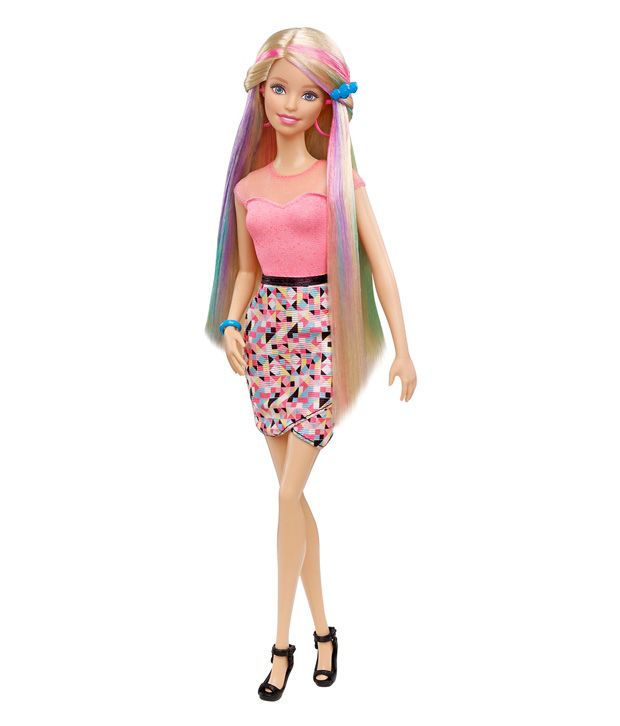
     Once upon a time there was a little girl who looked up to an unrealistic idol, Barbie. Spoiler alert: that little girl was me. From the time I was three years old I was taught to love Barbie. Everyone around me played with Barbie's; my sister, my cousin, my friends all had tons of them. In actuality I never saw anything wrong with the dolls until I read, "Our Barbie's, Ourselves." In fact, when I was little I looked up to her. She had everything I wanted in life: lots of talents, great careers, a beautiful house, and much more. But after I read, "Our Barbie's, Ourselves," I began to understand all the controversy surrounding the beloved toy. Emily Prager uses rhetoric, such as allusions and rhetorical questions, to reveal to readers the effect that Barbie can have on women. Girls who play with Barbie at a young age are taught that they should look like that doll. They are taught that in order to be 'beautiful' you must be tall, skinny, and blond, and you must have big breasts and a small waist. But, a girl looking exactly like a Barbie is about as realistic as my friends becoming pink elephants tomorrow. It's very unlikely- dare I say impossible. Today there are so many different people in the world who have such different body types and physical characteristics that the standard of perfection set by Barbie is even more outrageous than it was when she was first created. They say that perfection is in the eye of the beholder, but I think that no one can see you as perfect until you truly believe yourself to be perfect. Perfection is not only about looks but rather about who you are on the inside. Jesus Christ once said, "If you want to be perfect, go, sell your possessions and give to the poor and you will have treasure in heaven." In this quote, Christ makes no reference to beauty but instead suggests that the path to perfection involves sacrificing your wants for the sake of others. Perfection is a word that can mean a thousand different things to a thousand different people; just as Barbie can be considered a role model or a weapon against feminism (Prager), depending on who you ask.

Image result for original barbie doll  Image result for barbie doll  Image result for barbie doll

Sunday, October 23, 2016

Common Day Nazis

     Throughout the novel Maus, Spiegelman uses different animals to represent the different races and ethnicities of the characters in his book. He also shows some of the animals wearing masks, representing the varying appearances between the ethnicities. But, this also shows that underneath they are all the same. The use of masks serves to prove that a person's exterior is just that, a mask. The poem, "Please hear what I'm not saying," by Charles C. Finn addresses this topic really well.

 "Don't be fooled by me.
Don't be fooled by the face I wear
For I wear a mask, a thousand masks, 
Masks that I'm afraid to take off 
And none of them is me."
Finn is trying to explain that his exterior is not who he truly is; but rather a mask he puts on for the sake of others. Throughout the poem he explains that he is not at all who he appears to be. This really made me think about and analyze the different masks I wear throughout the course of a single day. Think about it. Most people act differently with their friends at lunch than they would with their boss at work. But who is to say which one is real? Each day we put on a series of different masks to try to fit in with the people around us. To try to be the person they want us to be. Although, high school is obviously different than the holocaust, it serves as a good comparison to daily life. In Auschwitz, if you had Jewish characteristics you were punished. In high school, people are judged based on appearances too. Lots of  people are  commonly considered outcasts because they don't look like the "normal" high school student. In essence, they are being discriminated against because they defy the social standard for normal. Most people think that the Holocaust was devastating and unfair. Hitler discriminated against the Jews because they were different. But isn't that what we do each day, make snap judgments based on appearances? Whether it's one person or a complete ethnicity, judging a person by the 'mask' they wear is wrong. In a society that is continuously growing and becoming more diverse, acceptance of others is critical.

Click here: http://www.jwjonline.net/poems/poem/mask/: to read the rest of the poem, "Please hear what I'm not saying."

Sunday, October 16, 2016

'Form meets Content'


      As kids, me and my brother read comics together all the time. From the age of five I was reading and understanding them by myself without difficulty. But as my brother grew up he stopped reading them, and so did I. I mean who reads comics in high school? No one. That is until I was assigned Maus to read. But just five pages in I could tell it was so much more than just a comic book. It's a novel that gives new meaning to the term 'form meets content.' Spiegelman explores abstract ways of conveying meaning and dances on the line between visual and verbal art to give life to his Fathers' story. Each page of this comic is filled to the edges with literary devices as well as visual symbols that work together to tell the story. However my favorite of these pages is page 84 (shown below).


     In just this one page Spiegelman incorporates multiple motifs. The first one is the stripes shown on the wallpaper in the background. These stripes most likely are meant to represent the stripes worn by the Jewish prisoners in the concentration camp. These are shown in background of the boxes where Vladek is telling Artie about how these events still make him sad. Spiegelman is using the visual of the stripes looming over Vladek to further demonstrate that these memories will never go away. The other motif shown on this page is that of the smoke. In the box in which Vladek is asking Artie not to smoke, the smoke rises from the bottom of the box to the top, separating the two men. In this visual alone it is clear that the smoke bothers Vladek and forms a barrier between him and his son. It can also be inferred that there is some lasting damage related to smoke from Vladek's days in the concentration camps. These visuals work alongside the words to help convey to the reader a deeper understanding of the story. One that could not be achieved using only words.

     Spiegelman helped me to have a new outlook on comics. Before reading Maus, I thought comics were solely for the purpose of entertainment and laughter. But I now understand that comics can reach new levels of literary complexity that normal novels cannot.
              

Sunday, October 9, 2016

Civil Disobedience vs. Rebellion

       Throughout Thoreau's speech, "Civil Disobedience," he suggests that sometimes the only solution to a problem is to not follow the rules. This is essentially the meaning of "civil disobedience." After looking up the definition in a dictionary I realized that it is eerily similar to the definition of rebellion. So I urge you to think about when civil disobedience becomes rebellion? Most people would say that civil disobedience is acceptable and rebellion is not. Why is that? Perhaps it is the word civil. Or maybe it's the fact that civil disobedience is associated with many famous protesters such as Martin Luther King Jr. Whatever the reason may be it's important to remember that there is a fine line between the two. When people remember the Freedom March and the French Revolution, they have very different opinions of the two. Both of these movements included an act against the government ruling them. But the Freedom March is regarded as a brave and noble protest against segregation. Whereas the French Revolution was a bloody and horrific time where many lives were lost. It was a tragic battle fought for a good cause. Now these examples are extremes, but they serve their purpose. Many people would argue that civil disobedience is a better approach to solving problems than rebellion is. Martin Luther King Jr. once said, "I became convinced that noncooperation with evil is as much a moral obligation as is cooperation with good.” In this quote he is suggesting that it is a moral obligation to object to unfair treatment. But it is important to remember that while it is right to protest unfairness and violation of rights; when doing so you must not infringe upon the rights of others. So once again I ask you: When does civil disobedience become rebellion?


What does it mean to be free?

    For the majority of my life I thought the answer was:  being able to say and do what you want. But after reading "This is Water," I now understand that the word freedom can have multiple definitions. Wallace argued that being free is having ,"attention, awareness." At first this quote didn't make an impact, until I remembered one of my favorite quotes.
"The aim of life is to live, and to live means to be aware, joyously, drunkenly, serenely aware,"
~Henry Miller
The reason this quote is so powerful is because it states a simple fact that is assumed to be general knowledge. "The aim of life is to live." Stating this seems redundant since most people know that the point of life is to live it. People won't argue that isn't true. But the part that makes this quote controversial is that it suggests that living is being aware; just as Wallace stated. Miller suggested that to live you must be aware. Wallace suggested that to be free you must be aware. Many people would say that freedom is a necessity to living an enjoyable life. Therefore being aware is essential in life. Now another controversial aspect of this quote is the meaning of the word aware. Like the word freedom, the word aware can have many definitions. Dictionary.com defines aware as: "having knowledge; conscious; cognizant." But for Wallace, being aware is understanding and caring for others. He also stated that to be truly aware you must care about things going on with others, rather than just noticing that they are there. "This is Water," prompted me to question what freedom really means. I still haven't come to a solid conclusion, but through the readings in class I have come to understand that freedom can mean one thing to one person, and the complete opposite to another. It all depends on what you believe being free really means. 

Image result for what does freedom mean 

Image result for what does freedom mean

Sunday, September 25, 2016

What is the Fourth of July?

            What is the Fourth of July? Many people would say the answer is simple: independence day. But in a country as diverse as the United States this question could be answered a thousand different ways. Lots of Americans view this as a day of celebration with family and friends. However, in Frederick Douglas' speech, "The Meaning of July Fourth for the Negro", he states," Fellow citizens, above your national, tumultuous joy, I hear the mournful wail of millions! whose chains, heavy and grievous yesterday, are, to-day, rendered more intolerable by the jubilee shouts that reach them". In this quote he is referring to the millions of slaves who have not yet been freed. How then can America rejoice in their freedom when all are not free? Douglas raises this question throughout his speech and prompts his fellow citizens to make a change. Since this speech was written in 1852 lots has changed. However, we are still a very divided country. There is still lots of discrimination that occurs each day throughout America. Many people say that we have made great progress in achieving equality among all races, and that is true but we still have a long way to go until we fully achieve equality. Another example of a race who is often discriminated against is the Native Americans. Looking at Fourth of July from their point of view you would imagine they would love the holiday right? I mean they were the first Americans. Actually, many Native Americans hate the holiday. For them it is just a painful reminder of the tragic history of their ancestors. To them the fourth of July celebrates the very people who forced them off their own land and almost ruined their whole culture. So for many people the Fourth of July is a day full of celebration and fun with the ones we love the most. But next Fourth of July we should also take a moment and think about how it would feel to be a member of a minority on a holiday solely for the majority.

Click here to listen to the speech by Frederick Douglas:

Image result for july fourth

Image result for july fourth for the negro

Sunday, September 18, 2016

Memorial for the Missing: Menin Gate

  
     The Menin Gate Memorial was built in 1927 by Reginald Blomfield. The memorial stands in Ypres, Belgium to commemorate the British and Commonwealth soldiers who fought in the Ypres Salient of World War 1, but have no known grave. This memorial is the one of the most visited in Western Europe. I chose to research this memorial because the architecture and history are very interesting. The memorial is built over a moat that the soldiers passed as they marched out of the city and into battle. However, the bridge was so dangerous due to shelling that many soldiers opted to go around it rather than cross directly. One poet, Siegfried Sassoon, wrote about the soldiers in a poem that reads,

 “Who will remember, passing through this gate,

The unheroic Dead who fed the guns?”

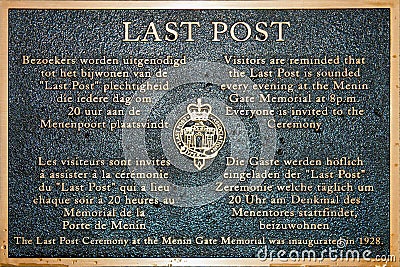
This poem explains that the men who will remember passing through the 'gate', instead of the memorial, will not be able to tell their story themselves as they were lost long ago. Originally, the site of the memorial was old town ramparts with just a bridge and two lions to the side of the bridge. The architect included the two lions in the memorial, one facing east toward the front line and one facing backwards towards the center of Ypres. These lions represent that there are two goals of the memorial, to look back and honor those who lost their lives in the war, and to look forward and cherish the life that they have because those soldiers fought to keep them free from German rule. Another interesting choice the architect made was to add columns on the outside of the memorial. This adds to the feeling of honor and valiance that help to remember the soldiers. On the inside and outside the names of 54,896 men are engraved into the memorial. Along with their names are their ranks in the war. By engraving their ranks as well as their names it gives the soldiers an identity. This shows that they had a place in live, that they are not just another name on a wall. But that they were real people who did amazing things for their country. However, the aspect that I found most intriguing about the memorial was its location. The memorial was built in Ypres because a large amount of soldiers were known to have fallen there. The architecture chose to build the memorial in this exact location because it was an integral part of the war. Most soldiers had to cross that bridge or 'gate' to get to the front line, and many died there due to shelling. I thought this was really interesting because, besides the obvious ties this location has to the war, it also could demonstrate the link between the dead soldiers and the living. By walking through the memorial you can imagine the soldiers journey bridging from life to death. Each night at 8 pm the 'Last Post' is rung to remember these brave soldiers. It has been rung every night except for when Belgium was taken over by the Germans during World War 2, but immediately begun again the day the Germans left. This location is still very important, even though there are no more battles there, just as the soldiers are still very important, even though they aren't fighting anymore.
Information from: http://www.historylearningsite.co.uk/world-war-one/world-war-one-and-casualties/the-menin-gate/

Menin Gate Memorial to the Missing Image result for menin gate at midnight Image result for menin gate memorial

Image result for menin gate memorial Image result for menin gate memorial Image result for menin gate memorial